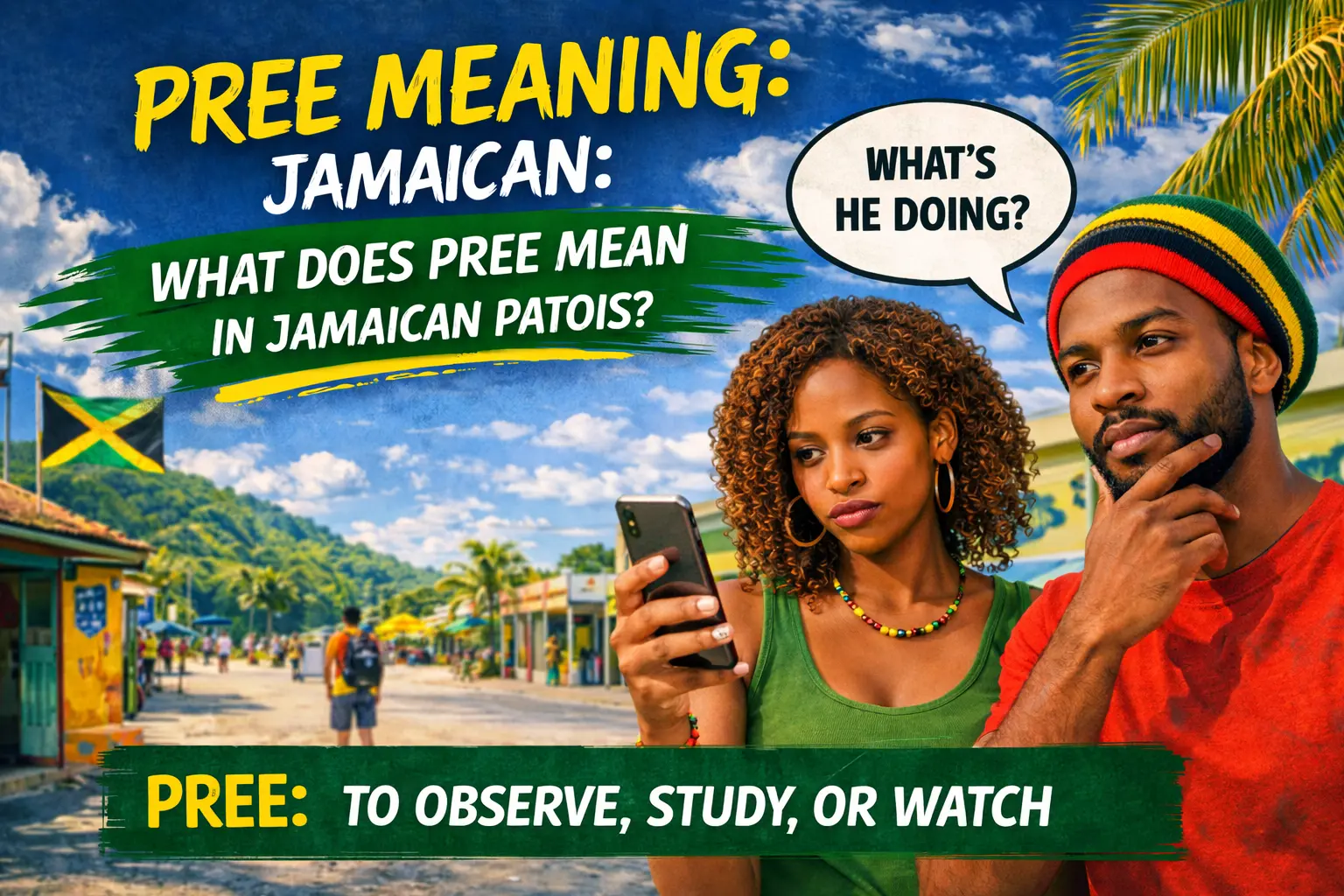
Pree Meaning Jamaican:
What Does Pree Mean in Jamaican Patois?
A complete guide to one of Jamaica’s most widely used slang words — its definition, usage, example sentences, and origins in Jamaican dialect.
To observe, watch, or pay close attention to something or someone. In Jamaican Patois, “pree” is a command or action word meaning to look carefully, listen intently, study, or take deliberate notice. It can also mean to think over or consider something deeply.
What Does Pree Mean in Jamaican Patois?
The pree meaning in Jamaican culture is more than a simple glance — it is an act of focused, deliberate attention. In Jamaican Patois, the word pree functions as a verb that tells someone to look, listen, or pay close attention to something or someone of importance. When a Jamaican says “pree,” they are instructing you to stop, take notice, and truly absorb what is being shown or said.
The pree meaning extends beyond just sight. Depending on the context, it can mean to study a situation carefully, to watch someone with interest, to listen closely to a tune or a story, or to think something over deeply. It is one of the most versatile and frequently used words in Jamaican slang, heard across Kingston street corners, dancehall events, and everyday conversations throughout the island.
Unlike many English words where looking and listening are separate acts, pree in Jamaican dialect captures both at once — it describes a state of total, focused attention. This makes it a uniquely expressive word in the Jamaican creole language, and one of the first expressions any student of Jamaican Patwa should learn.
Quick Reference — Pree at a Glance
| Language | Jamaican Patois (Patwa / Patwah) |
| Part of Speech | Verb (sometimes noun in phrases like “wah di pree”) |
| Core Meaning | To observe, watch, listen to, or pay close attention to |
| Extended Meanings | To study; to think over; to check out; to size someone up |
| Tone | Neutral — can be curious, admiring, or suspicious depending on context |
| Related Phrases | Wah di pree · Y pree · Mi a pree · Nuh pree |
The 4 Main Ways Jamaicans Use the Word Pree
Because pree is such a versatile term in Jamaican language, it shows up in several distinct ways depending on who is speaking and what they are talking about. Here are the four core usages every learner of Jamaican Patois should understand.
The most direct use — to look at something or someone with focus and intent. “Pree dat” = “Look at that.”
Used when drawing someone’s attention to a sound, song, or statement. “Pree dis riddim” = “Listen closely to this beat.”
A more contemplative use — to think something through carefully. “Mi a pree it” = “I’m thinking it over.”
To observe a person, sometimes romantically, sometimes with suspicion. “Him a pree yuh” = “He’s watching you.”
Pree in Jamaican Patois — Example Sentences
The best way to understand pree meaning in Jamaican culture is through real usage. Below are common Patois sentences featuring pree, paired with their English translations so you can see exactly how the word functions in everyday Jamaican dialect.
Related Jamaican Patois Phrases Using Pree
Once you understand the core pree meaning in Jamaican, you’ll start noticing related phrases built around the word. These Patois expressions are common across Jamaica, in dancehall music, and in Jamaican diaspora communities in the UK, the US, and Canada.
A Jamaican slang greeting used especially among young people — roughly equivalent to “What’s up?” or “What’s going on?” The phrase literally asks what the other person has been observing or what is happening.
“Wah di pree, bredda? Long time mi nuh see yuh.” — “What’s up, brother? I haven’t seen you in a long time.”
A shortened version of “Wah di pree” — a casual greeting asking what’s going on or what you’re up to. Very common in everyday speech among friends.
“Y pree dawg! Yuh deh touch di road likkle more?” — “What’s up, man! Are you going out later?”
First-person present continuous — “I am watching” or “I am thinking about it.” Commonly used to express interest in a person, idea, or situation.
“Mi a pree di new move dem mek.” — “I’m watching / studying the new moves they’re making.”
The negative form — “Don’t watch,” “Don’t observe,” or more loosely “Don’t worry about it.” Used to tell someone to mind their own business or to dismiss concern.
“Nuh pree dem — dem caan stop wi.” — “Don’t pay them any mind — they can’t stop us.”
“They are watching” — often used to warn that others are paying attention or keeping a watchful eye. Can carry a tone of caution or admiration.
“Mek sure yuh ready — dem a pree yuh every move.” — “Make sure you’re ready — they are watching your every move.”
The Origin of the Word Pree in Jamaican Culture
Linguists and scholars of Jamaican Creole trace the word “pree” to at least two possible roots. The most widely accepted theory is that it derives from the English word peer — meaning to look closely or attentively at something — which itself comes from the Middle English peren, meaning “to appear or look.” Over generations of Jamaican oral culture, “peer” was shaped into “pree” through the phonological patterns unique to Patois dialect.
A second theory suggests the word may descend from pry — meaning to inquire into something closely — adapted through the same pattern of local inflection that gives Jamaican speech its distinctive sound. Just as Jamaicans pronounce “prayer” as “prior” and “violence” as “voilence,” the word “pry” may have evolved into “pree” through natural linguistic drift.
A third possibility points to an older Scottish and northern English usage, where pree appeared around 1515 meaning “to prove or establish” — a word brought to Jamaica through British colonial contact and then reshaped by African linguistic influence into the rich, multi-layered Jamaican slang term it is today.
Whatever its origin, by the early 2000s “pree” had become deeply embedded in dancehall music and everyday Jamaican language, spreading through the diaspora to the UK, the US, and beyond.
Common Questions About Pree Meaning in Jamaican Slang
What is the pree meaning in Jamaican Patois?
In Jamaican Patois, pree means to observe, watch closely, or pay focused attention to something or someone. It can also mean to listen carefully, to study a situation, or to think something over. It is one of the most common and versatile words in Jamaican slang.
Is pree a positive or negative word in Jamaican?
The word pree is neutral in Jamaican dialect. Its tone — whether curious, admiring, or suspicious — depends entirely on context and delivery. “Pree dis riddim” (listen to this beat) is entirely positive, while “dem a pree yuh” (they’re watching you) may carry a cautious tone.
What does “wah di pree” mean?
“Wah di pree” is a popular Jamaican Patois greeting, especially among young people. It roughly translates to “What’s up?” or “What’s going on?” and is used to casually check in with a friend.
Where does the word pree come from?
The most common theory is that pree originates from the English word peer, meaning to look closely at something, which was adapted through Jamaican Creole phonology. Some linguists also link it to the word pry or to an older Scottish English term that entered Jamaican language through British colonial history.
Is pree used outside of Jamaica?
Yes. Through dancehall music, Caribbean communities, and cultural exchange, the word pree has spread widely — particularly in the United Kingdom’s Multicultural London English (MLE) and in Caribbean diaspora communities in North America and beyond. It is now recognized as part of broader Caribbean-influenced slang.
How do you use pree in a sentence in Jamaican?
Common uses include: “Pree dis” (Look at this / Listen to this), “Mi a pree yuh” (I’m watching / noticing you), “Pree di plan” (Study the plan), and “Wah di pree?” (What’s going on?). In each case, pree directs someone’s focused attention toward a person, sound, or idea.
Understanding Pree — The Full Picture
The pree meaning in Jamaican culture is fundamentally about directed, deliberate attention. Whether you are being told to listen to a song, observe a situation, study a plan, or notice a person, the word pree in Jamaican Patois captures all of these acts in a single, powerful syllable. It is not passive — it is a call to focus.
This quality makes pree one of the most expressive and economical words in the Jamaican dialect. Its usage spans music, greeting, romance, suspicion, and philosophical contemplation. In dancehall lyrics, in street conversations in Kingston, and in Caribbean communities across the globe, the word pree remains as alive and relevant as ever.
If you are learning Jamaican Patois, understanding the full range of the pree meaning will give you an immediate connection to the rhythm and logic of the language. And if you already speak it — well, yuh already know: just pree di ting.